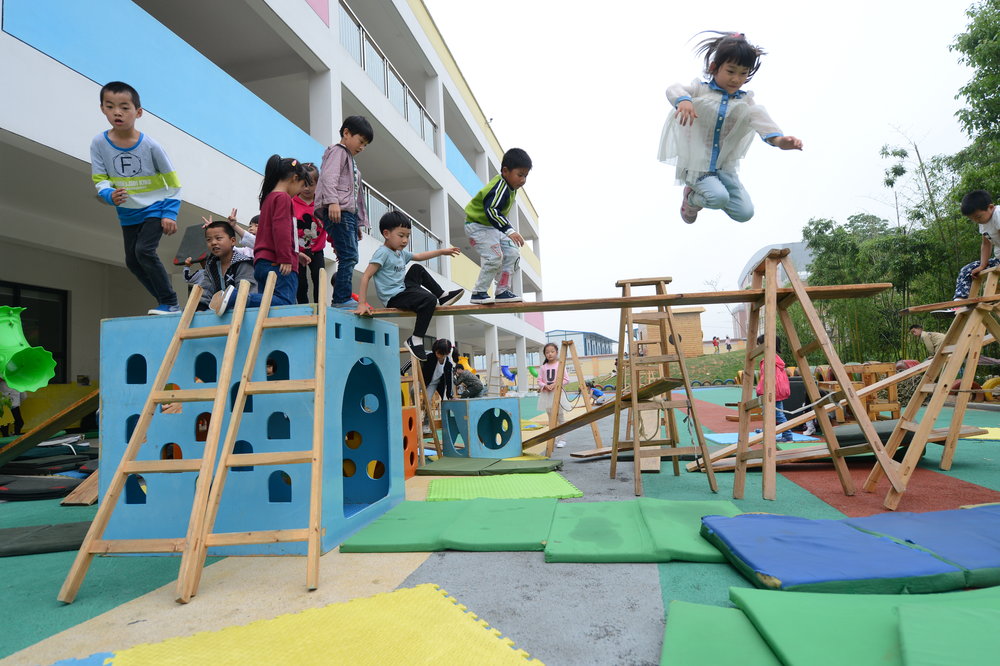
I recently discovered Anji Play through a classmate. I had first heard Anji Play referenced as highlighting the importance of risk in play. After researching more about Anji Play, watching some Youtube videos that show play in action, and listening to a speech by Ms. Cheng, the lead educator that has brought Anji Play to life, I am a believer that this approach will revolutionize the way children learn in the early years of life by centering in play.
Anji is a county in China. In the 1990s, Ms. Cheng took on an administrative leadership role to expand early learning sites throughout Anji county. Over the course of a decade, Ms. Cheng increased access to early childhood education by growing school sites from 4 to 130 across the county.
Ms. Cheng had spent her career as a teacher, she notes a period of time when early education had “no play.” Educators then started to construct and prescribe play for children, she calls this period of time “false play.” Ms. Cheng asked herself, “what is true play?” Out of this question, Anji Play was born.
Anji Play’s website defines Anji Play as returning the right of self-determined True Play to children and communities in environments defined by Love, Risk, Joy, Engagement, Reflection.
The concept of love in education deeply interests me. I have thought of love in education as creating a sense of belonging for children to express themselves, feel heard and supported. In Anji Play, love also enables risk. Through love, children feel a sense of safety and security, it is from this place of stability that children can take risks to explore the edges of their comfort zone. Through love, the child does not fear failure instead failure is a part of the learning process that encourages further exploration.
Children have a natural inclination to play, it is their means of expression and a wellspring of creativity and imagination. Anji Play makes play the foundation to all learning, meaning they prioritize this time in the child’s day allotting hours of play to develop over the course of the day. As children play, authentic joy and flow emerge.
The teacher’s role is to create an environment that is inviting of play, to observe children, and to document their play. Teachers will often use technology to document by recording on their phones. Through documenting, the teacher can reflect on the child’s play to gain insight into the child’s experience. Teachers can observe and document how the child is engaging – is the child coordinating play with their peers? Are they focused on details? Is their play fantasy based? Are they creating something tangible or acting out scenarios and stories? Do they gravitate toward movement, visuals, textiles? Children’s play will likely encompass all of the above and countless other variations. Documenting and reflection allow for insights to be gained about each individual child so that the teacher may best understand the child in their authenticity, support their unique learning modalities and provide guidance to assist the child toward greater discovery.
Anji Play invites children to reflect on their play and dedicates time for the child to process their experience, for example, the child may reflect on their intentions, their thought processes, their emotions, and the sequencing of actions that they took – this type of reflection can be a practice in metacognition and awareness. Parents are also encouraged to be a part of their child’s reflection by attending meetings to learn about their child’s experiences, the benefits of this are many as it strengthens the connection between school and home, as well as provides depth of understanding between parent and child with a respect toward the child’s capabilities and growing capacities.
Play is fundamental to children’s learning. Indeed as Anji Play affirms, play is the right of the child.
Image source: anjiplay.com
 Learning to Create.