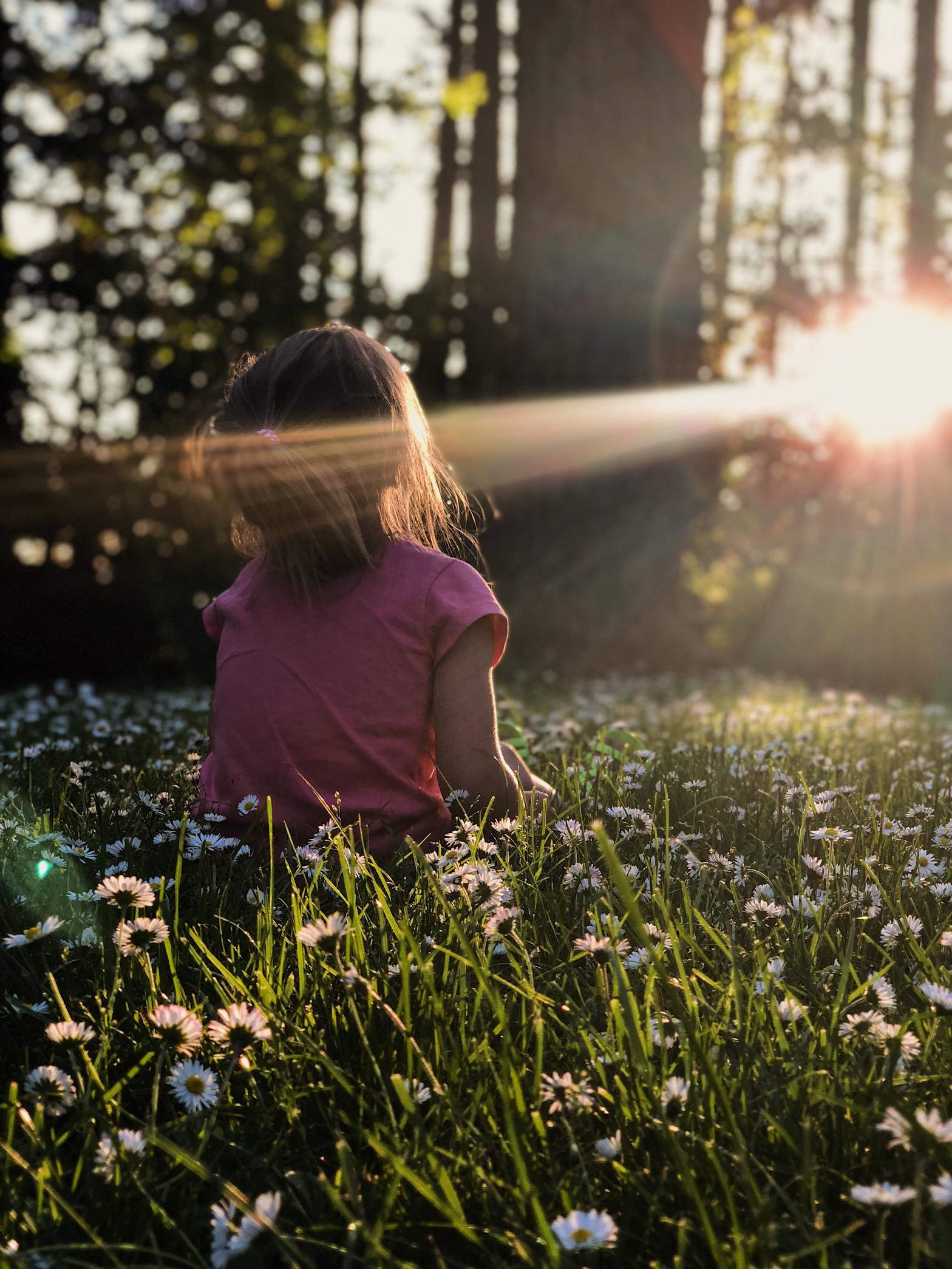
When I worked as a caregiver in a child care and preschool setting in a high population dense city, we were fortunate to have a contained outdoor space. I use the word contained because even though there was a busy street just on the other side of the gate, the space felt distinctive and like a portal away from the city’s people passing by and occasional honking horns. Sometimes, sound filtered in but the feeling of the space held its own. The outdoor space felt enchanted and engaging with abundant leafy greens in vegetable gardens, plentiful fruit trees, lush grass, familiar mud puddles, swing sets, play houses, a sidewalk to draw on and ride tricycles, flowers and ivy growing healthily along the perimeter, sand boxes, water tables, and climbing structures.
Every day there was time outside, rain or shine, significant time outside before and after lunch and naps, was a daily priority.
While outside, we could slow down and speed up. Slowing down could be taking time to listen to the bird’s song, watching a snail leaving a silvery trail, sinking our noses into delicate flower petals to smell the fragrance, marveling at new plump growth in the garden, observing the butterflies fluttering by and the bees collecting honey. Speeding up could look like playing games like tag, running up and down a little hill (the little hill was intentionally built with a gentle slope about 2 ft high for the children to roll, and run up and down on), jump, skip, twirl, swing, tumble, and more.
Having wide open spaces in nature to breathe fresh air, feel the sun, the rain, the coziness of clouds and absorb nature’s palette of colors is innately soothing to our nervous system. For children, a relationship with nature at an early age provides an intuitive and supportive connection to being a part of the larger wholeness of life. The sense of belonging that arises when building a relationship with nature provides a powerful source of support, wisdom, and healing throughout life.
Connection to nature is a wonderful way to establish a sense of internal rhythm. I think of rhythm as being the ease at which we flow with time and transition. Just as the four seasons flow through transitions with ease and grace, we can also learn to flow with the rhythm of transitions that occur throughout our day and the major transitions that shape the course of our life.
Being in nature activates a somatic, physical experience as we tune in with our senses. Nature helps us build healthy mental and emotional capacities and has many lessons to share with us. For instance, nature can be a guide to learning about patience, the fruit takes its time to grow and though we don’t always see a daily transformation, growth is happening and soon we may enjoy the crisp juiciness of an apple or the balanced sweetness of a berry. Similar to patience, nature teaches us the power of consistent care, as we water the seed we slowly begin to see a green stem emerge from its shell. Nature teaches us to be resilient, the cycles of the forest show us that new growth arises from the natural destruction of old growth. Nature teaches us about generosity as we learn about the abundance of our earth and her sustaining resources to support all forms of life. Nature teaches us about innovation by learning about the adaptability of life over time to respond to changes in the environment.
Nature also teaches us about gratitude and reciprocity. A favorite book of mine is called Braiding Sweetgrass by Robin Wall Kimmerer. In this beautifully written book, the author weaves together “indigenous wisdom, scientific knowledge and the teaching of plants.” Kimmerer richly shares her intuitive connection to nature. As the reader, her words were both nourishing and enlightening. Throughout Braiding Sweetgrass, Kimmerer brings forth the need for gratitude and reciprocity in our relationship with nature.
Kimmerer writes:
“cultures of gratitude must also be cultures of reciprocity. Each person, human or no, is bound to every other in a reciprocal relationships. Just as all beings have a duty to me, I have a duty to them. If an animal gives its life to feed me, I am in turn bound to support its life. If I receive a stream’s gift of pure water, then I am responsible for returning a gift in kind. An integral part of a human’s education is to know those duties and how to perform them…duties and gifts are two sides of the same coin. Eagles were given the gift of far sight, so it their duty to watch over us. Rain fulfills its duty as it falls, because it was given the gift of sustaining life. What is the duty of humans? If gifts and responsibilities are one, then asking ‘What is our responsibility?’ is the same as asking ‘What is our gift?’ It is said that only humans have the capacity for gratitude. This is among our gifts. It’s such a simple thing, but we all know the power of gratitude to incite a cycle of reciprocity” (pg. 115).
As we cultivate gratitude and reciprocity in nature, we can extend this to the relationships we develop with ourselves and to each other.
Facilitating the building of a relationship between a child and nature seeds the child with fruitful gifts to be harvested throughout their life. This relationship also provides the child with an evergreen sense of belonging understanding themselves as an interconnected part of nature. The child also learns to trust that they always have access to the wisest and most generous teacher of all, Mother Earth.
Photo by Melissa Askew on Unsplash
 Learning to Create.